

THE UNIVERSITY OF OSAKA
Graduate School of Engineering
Department of Applied Physics
Ono Laboratory
About
Ono Lab. works on automating experiments and making them autonomous, as well as on building the fundamental models that support this. By using robots and AI to automate challenging experimental operations, such as handling powders and highly viscous fluids, and by digitizing the tacit knowledge of experts, we aim to realize fully autonomous measurement and experimental systems. As core technologies underpinning autonomous experimentation, we also develop physical and mathematical models for optimal experimental design, large-scale measurement data analysis, and inverse materials design.
Join us! We accept fourth-year undergraduates in the Applied Physics program of the School of Engineering, as well as graduate students in the Department of Applied Physics, Graduate School of Engineering, The University of Osaka. Students from other universities are also welcome to join us for graduate study. For details, please see For Students.

News
View all →

Research
More →
Autonomous Laboratory
We robotize and automate challenging materials science processes — powder handling, mixing, coating — combining robotic precision with expert tacit knowledge to build fully autonomous experimental systems.

Mathematical Modeling for Autonomous Experimentation
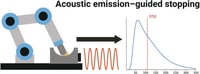
We build the theoretical foundations for autonomous experimentation — Bayesian experimental design, optimal design, and optimal stopping — alongside physics-based models for optimal measurement and process control.

Materials Informatics
We apply AI and machine learning to large-scale quantum-beam datasets to map material space and uncover hidden properties, and develop inverse design models to discover new materials from desired specifications.